The short answer
For the best flow and filtration, the Clearsource Ultra 2-Stage external system is our top pick — its final stage handles big Class A fixtures without choking flow. Want virus and bacteria protection built into the rig? The Clearsource OnBoard Pro 3-Stage adds VirusGuard. The Camco EVO X2 is a strong no-canister mid-range choice, and the Camco TastePURE inline filter is the category best seller for under $25 — a smart minimum for every RVer.
Why we're confident: filter picks weigh flow rate against micron rating, because a filter that kills your water pressure is one you will stop using.
Quick picks
- Best overall: Clearsource Ultra 2-Stage External System — strong flow for big Class A fixtures. Premium · ~$300–360
- Best whole-rig: Clearsource Ultra OnBoard Pro 3-Stage (VirusGuard) — virus, bacteria & cyst protection. Premium · ~$600
- Best mid-range: Camco EVO X2 Dual-Stage Premium Filter — 0.5-micron carbon block, no canister. Mid · ~$45–60
- Best canister value: Hydro Life HL-200 External Canister Kit — reusable housing, replaceable cartridge. Mid · ~$45–70
- Best budget: Camco TastePURE Inline Water Filter (40043) — the category best-seller. Budget · ~$20–25
- Best budget alternate: Clear2O RV Inline Water Filter — alternate budget inline. Budget · ~$25–35
- Best dual-canister value: Beech Lane Dual RV Water Filter System — two-canister sediment + carbon kit. Mid · ~$110–140
The three filter types
| Type | What it does | Best for | Trade-off |
|---|---|---|---|
| Inline (disposable) | Single carbon/sediment cartridge on the hose | Weekenders, renters, simplicity | Lower capacity, replace often |
| Canister (1–2 stage) | Refillable housings: sediment + carbon block | Full-timers, picky water | Costs more, takes a little space |
| Under-sink / countertop | Dedicated drinking-water polish (often 0.5 micron) | Best taste at the tap | Filters only one faucet |
Most happy setups are a layered approach: a coarse sediment filter first (protects everything downstream and makes the good filter last longer), then a carbon block for chlorine, taste, and odor. A 20-micron sediment stage followed by a 0.5–5 micron carbon block covers the vast majority of campground water.
Compare the picks
| Product | Tier | ~Price | Best for |
|---|---|---|---|
| Clearsource Ultra 2-Stage External System | Premium | ~$300–360 | Best overall external system, big Class A flow |
| Clearsource Ultra OnBoard Pro 3-Stage (VirusGuard) | Premium | ~$600 | Whole-rig virus, bacteria & cyst protection |
| Camco EVO X2 Dual-Stage Premium Filter | Mid | ~$45–60 | True 0.5-micron carbon block, no canister |
| Hydro Life HL-200 External Canister Kit | Mid | ~$45–70 | Lowest-cost way into a real canister setup |
| Beech Lane Dual RV Water Filter System | Mid | ~$110–140 | Two-canister sediment + carbon staging |
| Camco TastePURE Inline Water Filter (40043) | Budget | ~$20–25 | Cheapest no-install starter and backup |
| Clear2O RV Inline Water Filter | Budget | ~$25–35 | Finer inline media for better taste |
The reviews
Clearsource Ultra 2-Stage External RV Water Filter System

Premium · ~$300–360 · best all-around external system
The system full-timers settle on: a coarse sediment stage protects everything downstream, then a 0.2-micron coconut-shell carbon block pulls chlorine, taste, and cysts. The aluminum stand and oversized housings keep flow strong even feeding the larger fixtures on a Class A coach. The benchmark external setup.
Pros
- Strong flow for big Class A fixtures
- 0.2-micron carbon block + sediment pre-filter
- Rugged stand, standard cartridges
Cons
- Takes up bay/storage space
- Higher up-front cost
Clearsource Ultra OnBoard Pro 3-Stage (VirusGuard)
Premium · ~$600 · whole-rig, virus/bacteria/cyst protection
The top of the line: a permanently mounted three-stage system that adds a VirusGuard stage to remove viruses, bacteria, and cysts on top of sediment and carbon. It treats every tap in the coach, not just one, so you get protected water at the shower, galley, and ice maker. For anyone serious about water safety in unknown campgrounds, this is the no-compromise option.
Pros
- Removes viruses, bacteria & cysts
- Treats the whole rig, every tap
- Three-stage protection, mounted onboard
Cons
- Most expensive option here
- Permanent install required
Camco EVO X2 Dual-Stage Premium RV Water Filter
Mid · ~$45–60 · 0.5-micron carbon block, no canister
Real two-stage filtration without committing to a full canister rig. The EVO X2 pairs a spun sediment pre-filter with a 0.5-micron carbon block, so it actually pulls fine particles, chlorine, and taste rather than just knocking off the worst of it. The smart step up from a throwaway inline for owners who want better water without the bulk.
Pros
- True 0.5-micron carbon block
- Dual-stage in a compact body
- Replaceable cartridges
Cons
- Lower flow than full canisters
- Cartridges cost more than inlines
Hydro Life HL-200 External Canister Kit
Mid · ~$45–70 · reusable housing, replaceable cartridge
The affordable way into a real canister setup. You get a reusable external housing and a replaceable KDF/carbon cartridge, so ongoing cost is just the refill rather than a whole new filter each season. A practical mid-tier choice for owners who want canister-grade filtration on a smaller budget.
Pros
- Reusable housing, cheap refills
- KDF + carbon for taste and metals
- Lower cost than premium canisters
Cons
- Single stage — no separate sediment pre-filter
- Coarser than a 0.5-micron block
Beech Lane Dual RV Water Filter System
Mid · ~$110–140 · two-canister sediment + carbon kit
A true two-canister setup for less than half the price of a premium rig. Beech Lane runs a sediment pre-filter into a carbon block, mounted on a steel bracket with a built-in pressure gauge so you can watch flow drop and know when to swap cartridges. The sensible middle ground for full-timers who want real staged filtration without the Clearsource price tag.
Pros
- Real two-canister sediment + carbon staging
- Built-in pressure gauge
- Steel mounting bracket, standard cartridges
Cons
- Bulkier than inline or single-canister kits
- Cartridges not as fine as 0.2-micron premium blocks
Camco TastePURE Inline Water Filter (40043)
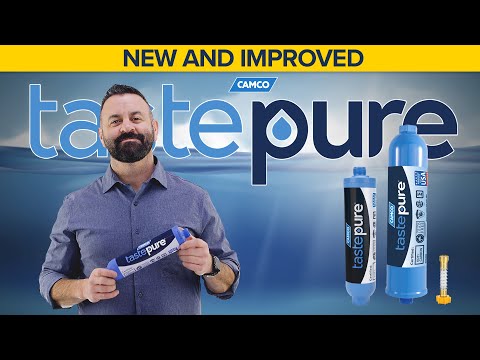
Budget · ~$20–25 · the category best-seller
Screw it onto the spigot, attach your hose, done. It will not match a carbon block, but it removes chlorine taste and sediment for a season and costs about as much as two coffees. This is the filter nearly every RVer starts with — and a perfect cheap backup to keep in the bay even after you upgrade.
Pros
- Cheapest entry point, zero install
- Best-selling, easy to find anywhere
- Great backup filter
Cons
- Low capacity, replace each season
- Can restrict flow as it clogs
Clear2O RV Inline Water Filter
Budget · ~$25–35 · alternate budget inline
A solid alternative to the TastePURE for owners who want finer filtration in the same easy inline format. Clear2O uses a tighter carbon-block media than most disposable inlines, so it does more on taste and fine particles — at the cost of somewhat lower flow. A good budget pick when filtration matters more than raw GPM.
Pros
- Finer carbon-block media than typical inlines
- Inexpensive, no install
- Better taste/odor removal
Cons
- Lower flow rate
- Shorter cartridge life
See it in action
Official demos and hands-on walkthroughs of our picks. Videos play right here via YouTube.
How to choose
1. Match the micron rating to the job
Lower micron = finer filtration. A 20-micron sediment filter protects your system; a 0.5–5 micron carbon block handles taste and finer particles. Don't put a 0.5-micron filter first — it'll clog on sand in a week.
2. Filter in stages
Sediment first, carbon second. A coarse pre-filter is cheap and dramatically extends the life of the expensive cartridge behind it.
3. Watch your flow rate
Finer filters slow water down. If your shower turns weak after adding a filter, you've either got a clogged cartridge or one rated for too little flow — size up the housing, not down the micron.
4. Don't forget the hose
A drinking-water-safe (white) hose and a filter are a team. The best filter in the world can't fix water that picks up taste from a cheap garden hose downstream.
Frequently asked questions
What micron rating do I actually need for an RV water filter?
For sediment protection, a 20-micron filter catches sand, rust, and grit without clogging quickly. For taste, odor, and finer particles, pair it with a 0.5-to-5-micron carbon block. Putting a fine filter first will clog it fast, so always run coarse-to-fine.
Do I need a special filter for a big Class A motorhome?
Larger coaches have more fixtures and higher peak demand, so flow rate matters more than on a small trailer. An oversized canister or external system like the Clearsource Ultra keeps shower and galley pressure strong, where a small inline filter may feel weak. Size up the housing rather than down the micron rating.
How often should I replace my RV water filter cartridge?
Disposable inline filters generally last one camping season or a few months of regular use. Canister cartridges last longer, but the real signal is dropping flow or returning taste and odor, which is why a pressure gauge on a canister rig is handy. Replace sooner if you have been on heavy sediment or well water.
Will a water filter remove bacteria and viruses?
Standard sediment and carbon filters improve taste and remove chlorine, sediment, and some cysts, but they do not reliably remove viruses or bacteria. For that you need a dedicated stage such as the VirusGuard found on the Clearsource OnBoard Pro, or a separate purification step. Most campground municipal water is already treated, so this matters most on questionable or well-source sites.
Can I leave my external water filter connected over winter?
No. A wet cartridge can freeze, crack the housing, and breed bacteria if left damp in storage. Drain the filter, remove disposable cartridges, and store the housing dry when winterizing your rig.
Related guides
Best RV Sewer Hoses
The other half of the water system — reliable, leak-free waste handling at the dump station.
Read the guide →Best RV Surge Protectors
Protect your pump, water heater, and everything else from bad campground power.
Read the guide →Best RV Roof Vent Fans
Pull out cooking moisture and shower humidity to keep the cabin fresh and dry.
Read the guide →