The short answer
For most towable RVs, the Andersen Camper Leveler is the best pick in 2026 — you drive onto it until level, with no stacking math or guesswork. Pair it with a LevelMatePRO+ so your phone shows the exact lift each side needs, and add BAL X-Chock stabilizers to kill the rock once you are level. Interlocking blocks (Camco FasTen or budget Tri-Lynx) remain the cheap, proven standard. Class A owners with auto-levelers should add RV SnapPad jack pads.
Why we're confident: leveling is a small system (leveler + gauge + stabilizer), so we pick the best in each role rather than one do-everything product.
Quick picks
- Best Overall: Andersen Camper Leveler 3604 — drive on, no stacking math, done in seconds. Premium · ~$80
- Best Tech: LogicBlue LevelMatePRO+ Wireless — your phone tells you the exact lift for each side. Premium · ~$150
- Best for Class A Auto-Levelers: RV SnapPad Xtra Permanent Jack Pads — snap-on pads that never get left behind. Premium · ~$240
- Best Volume Seller: Camco FasTen Interlocking Leveling Blocks — the default 10-pack, rated to 40,000 lb. Mid · ~$50
- Best Budget: Tri-Lynx Lynx Levelers — proven cheap standard with a 10-year warranty. Budget · ~$42
- Best Stabilizer: BAL X-Chock Wheel Stabilizer — locks the wheels to kill the rock once you are level. Mid · ~$70
Compare the picks
| Product | Tier | ~Price | Best for |
|---|---|---|---|
| Andersen Camper Leveler 3604 | Premium | ~$80 | Best overall — drive-on, no stacking |
| LogicBlue LevelMatePRO+ Wireless | Premium | ~$150 | Exact per-side lift from your phone |
| RV SnapPad Xtra Permanent Jack Pads | Premium | ~$240 | Class A hydraulic auto-levelers |
| Camco FasTen Interlocking Blocks | Mid | ~$50 | Volume seller, rated 40,000 lb |
| Tri-Lynx Lynx Levelers | Budget | ~$42 | Budget standard, 10-year warranty |
| BAL X-Chock Wheel Stabilizer | Mid | ~$70 | Killing the rock on tandem axles |
The reviews
Andersen Camper Leveler 3604 (2-Pack, Includes Chocks)
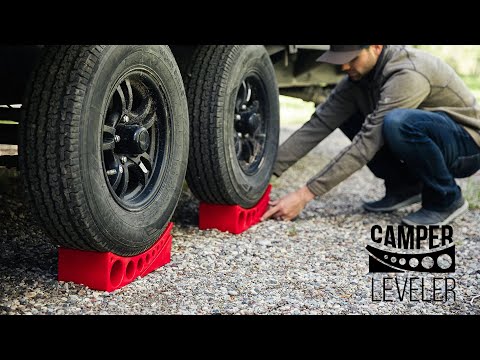
Premium · ~$80 · the one everybody recommends
You pull the curved ramp in front of the tire, drive up until the bubble centers, then drop the wedge to lock it — no stacking, no math, no backing up three times. It is the most-loved RV leveler for good reason, and the bundled chocks mean you are not buying a second product.
Pros
- Drive-on, infinitely adjustable height
- No counting or stacking blocks
- Comes with curved chocks
Cons
- Pricier than plain blocks
LogicBlue LevelMatePRO+ Wireless Bluetooth Leveling System
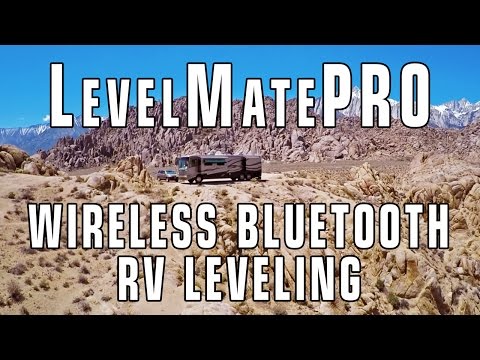
Premium · ~$150 · know the lift before you stack a thing
Mount the sensor once, open the app, and it shows precisely how many inches each side needs to come up. No more walking around with a bubble level squinting at the door frame. Pair it with blocks or an Andersen and you nail level on the first try.
Pros
- Exact per-side height readout on your phone
- One-time install, works for years
- Removes all the guesswork
Cons
- Needs blocks or a leveler to actually lift
RV SnapPad Xtra Permanent Jack Pads (for Lippert/LCI Auto-Leveling)
Premium · ~$240 · never chase a loose pad again
If your Class A has Lippert/LCI hydraulic auto-levelers, these snap permanently onto each jack foot. The jacks deploy straight onto rubber every time — no scrambling to slide pads under before the coach settles, and no protecting concrete or asphalt by hand.
Pros
- Snaps on once, stays on forever
- Protects pavement and jack feet
- No loose pads to store or lose
Cons
- Must match your exact jack foot model
Camco FasTen Interlocking Leveling Blocks (10-Pack)
Mid · ~$50 · the dependable default
These snap together like big Legos so your stack does not slide out from under the tire. Rated to support up to 40,000 lb, they handle everything from a teardrop to a big fifth wheel, and they store flat in a small bag.
Pros
- Interlock so the stack stays put
- Supports up to 40,000 lb
- Stack to whatever height you need
Cons
- Stacking still takes trial and error
Tri-Lynx Lynx Levelers (10-Pack)
Budget · ~$42 · the proven cheap standard
The original interlocking honeycomb blocks that have been under RVs for decades. They stack into a ramp or a pad, shrug off weather, and carry a 10-year warranty. Hard to beat for the money if you do not mind stacking.
Pros
- Time-tested, widely used design
- 10-year warranty
- Lowest cost per block
Cons
- No drive-on convenience
BAL X-Chock Wheel Stabilizer (Pair)
Mid · ~$70 · stops the rocking after you level
Leveling gets you flat; the X-Chock gets you steady. It wedges between the two tires on a tandem axle and ratchets tight, locking the wheels against each other so the camper stops rocking every time someone walks across the floor.
Pros
- Dramatically cuts side-to-side rock
- Doubles as a wheel chock
- Tightens with a standard ratchet
Cons
- Only fits tandem-axle trailers
See it in action
Official demos and hands-on walkthroughs of our picks. Videos play right here via YouTube.
How to choose
Match the gear to your rig
A towable that drops a low corner just needs blocks or a drive-on leveler. A Class A with hydraulic auto-levelers does the lifting itself but still needs jack pads so those feet do not sink into gravel or crack pavement. Buy for what your coach actually does, not for the most expensive option on the shelf.
Decide how much you hate stacking
Plain blocks are cheapest but mean drive-up, check, back-off, add a block, repeat. A drive-on leveler like the Andersen erases that loop, and a Bluetooth tool like the LevelMatePRO+ tells you the exact height up front so you stop guessing. If you camp often, the time saved pays for the upgrade quickly.
Do not forget stabilizing
Level and steady are two different problems. Once you are flat, an X-Chock or quality stabilizer kills the annoying rock when you move around inside. It is the cheap finishing touch that makes the rig feel solid.
Check weight ratings and storage
Confirm the blocks or pads are rated above your loaded axle weight, and look at how the set packs down. Good leveling kit lives in a basement bay all season, so a compact bag and weather-proof material matter more than you would think.
Frequently asked questions
How do drive-on levelers like the Andersen work?
You place the curved ramp in front of the low-side tire and drive up onto it until a bubble level reads flat, then drop the included wedge to lock the tire in place. There is no stacking or counting blocks, so it usually takes seconds rather than several rounds of trial and error.
Do I need a leveling system if my Class A has hydraulic auto-levelers?
The coach does the lifting itself, but you still want jack pads under each foot so the jacks do not sink into gravel or crack pavement. Snap-on pads like the SnapPad attach permanently to the jack feet so there is nothing loose to slide under or lose.
What weight rating do leveling blocks need?
Confirm the blocks or ramps are rated above your loaded axle weight, not just the trailer's dry weight. Interlocking blocks such as the Camco FasTen are rated to support up to 40,000 pounds, which covers everything from a teardrop to a heavy fifth wheel.
What is the difference between leveling and stabilizing?
Leveling gets the rig flat front to back and side to side; stabilizing stops the bounce and rock when you move around inside. A wheel stabilizer like the BAL X-Chock wedges between tandem-axle tires to lock them together, which is the cheap finishing touch after you are level.
Will an X-Chock fit a single-axle trailer?
No. The X-Chock works by ratcheting tight between two tires on a tandem axle, so it needs a pair of wheels close together to brace against. A single-axle trailer needs conventional chocks and stabilizer jacks instead.
Related guides
Best Weight-Distribution Hitches
Tow level and sway-free before you even reach the campsite.
Read the guide →Best RV Backup Cameras
See behind a long coach when backing into a tight, uneven site.
Read the guide →Best RV Tire Pressure Monitors
Keep an eye on tire pressure and heat on every leg of the trip.
Read the guide →